





Heavy equipment maintenance in Fort Worth is a critical priority for any operation running construction, industrial, or earthmoving machinery across North Texas. Whether you manage a single jobsite or a multi-site fleet, unplanned breakdowns cost time, money, and safety.
Here’s a quick overview of what effective heavy equipment maintenance in Fort Worth involves:
These steps apply whether you’re running Cat, Komatsu, John Deere, or any other major brand across the Fort Worth area.
We’re DFW Movers & Erectors, and in this guide we’ll walk you through exactly how to build a reliable maintenance strategy that reduces downtime and protects your equipment investment.
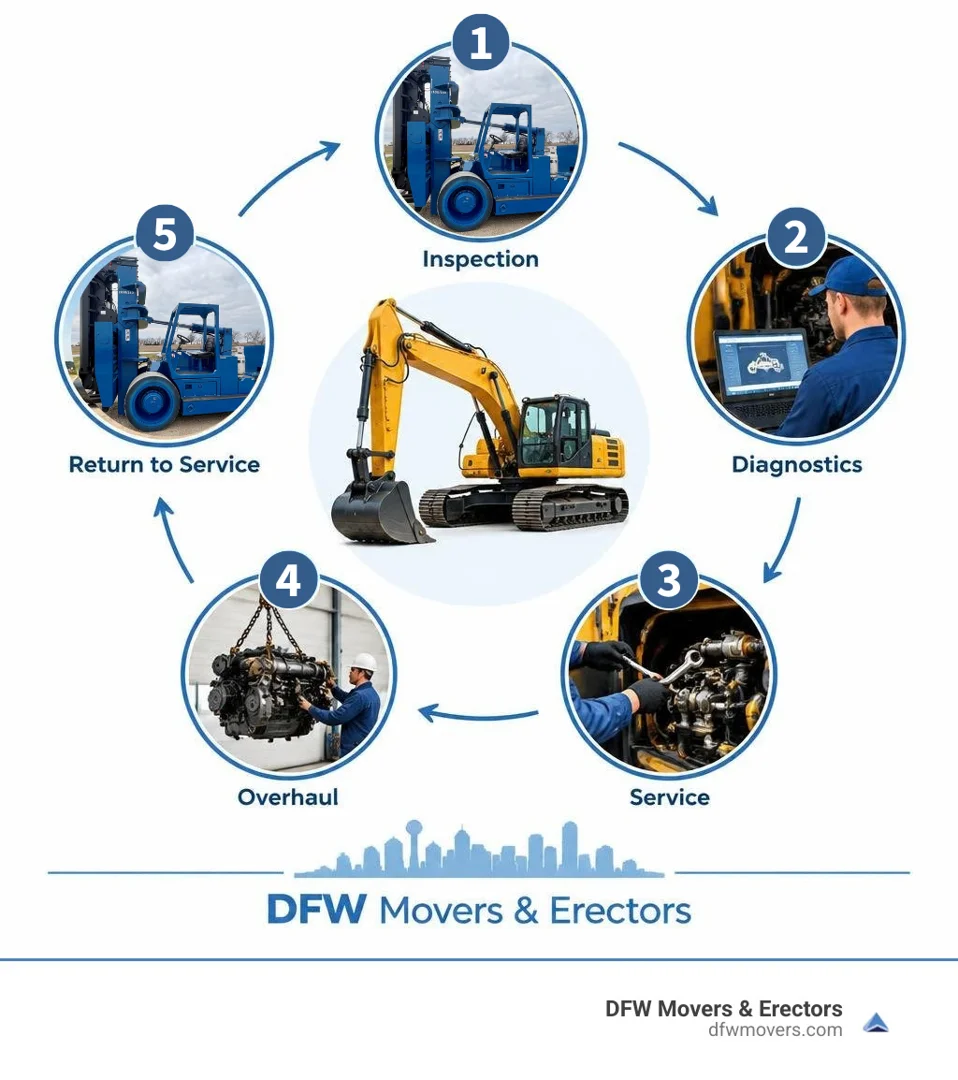
Maintaining heavy machinery across North Texas demands a disciplined, systematic strategy. Fort Worth’s harsh weather conditions—ranging from scorching summer heat over 100°F to sudden winter freezes—put intense wear and tear on heavy machinery. Dust, clay, and constant heavy lifting accelerate component friction and degradation. Implementing proactive preventative care is the single most effective way to eliminate surprise failures and maximize machinery longevity.
A robust maintenance protocol relies on clear checklists, operator discipline, and routine tracking. When equipment operators perform thorough daily pre-shift walkaround inspections, they catch minor issues, such as hairline fluid hose cracks, low coolant levels, loose track tension, or worn pins, before they turn into catastrophically expensive engine seizures or hydraulic structural failures.
To keep your fleet in prime working order, explore our comprehensive Industrial Machine Maintenance Guide to structure your organization’s internal inspection routines.
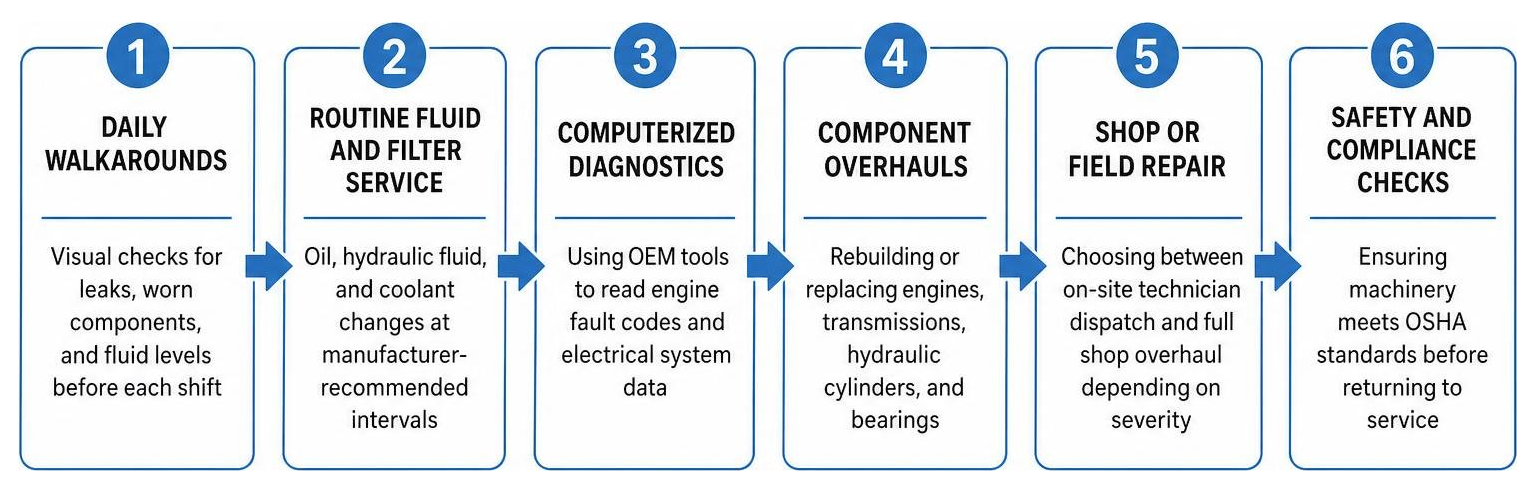
Fluids are the lifeblood of heavy industrial equipment. Neglecting oil, coolant, transmission, and hydraulic fluids is the leading cause of premature engine and hydraulic system failure. In high-demand jobsites across Fort Worth, continuous engine loading generates excessive friction heat, which breaks down chemical additives in fluid systems over time.
Modern heavy equipment relies as heavily on electronic control modules (ECMs) and sensor networks as it does on mechanical gears. When an engine fault light triggers or hydraulic response slows down, field technicians must combine mechanical expertise with high-tech computerized diagnostic tools.
By connecting factory-grade diagnostic software directly to the machine’s onboard network, technicians read real-time fault codes, evaluate sensor voltages, and perform active component tests. Diagnostics go beyond simply clearing fault codes; technicians analyze operational telemetry to pinpoint underlying electrical harness shorts, failing pressure transducers, or fuel injection timing errors.
Furthermore, technicians must possess the specialized training needed to read and interpret complex OEM schematics. Electrical schematics, hydraulic flow diagrams, and mechanical blueprints are essential when troubleshooting complex multi-system failures on heavy cranes, excavators, and industrial loaders.
When a machine fails on a busy jobsite in North Texas, project managers must quickly decide whether to repair the equipment directly in the field or transport it to a dedicated machine service shop. Both options serve vital functions, and choosing the right path directly impacts project timelines, safety, and repair costs.
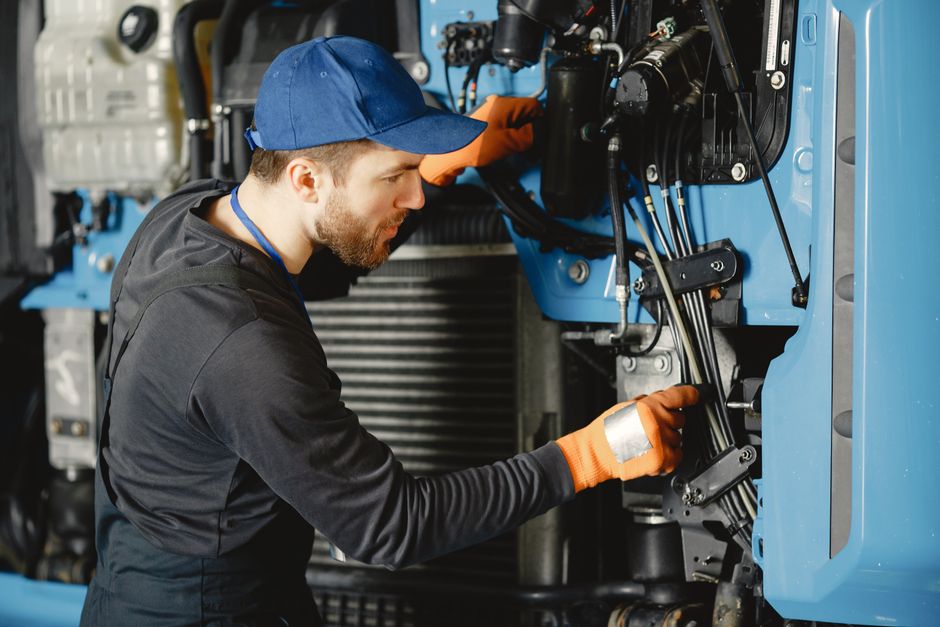
Field service is designed for maximum speed and convenience. Mobile technicians equipped with specialized service trucks can handle urgent breakdowns, routine fluid changes, sensor replacements, hose fabrications, and minor welding jobs right on site. This eliminates the expense and delay of hauling massive machines across the metroplex.
However, complex component rebuilds, major engine overhauls, structural modifications, and precision shaft alignments require the controlled environment of a fully equipped repair facility. Shop environments provide overhead cranes, heavy-duty hydraulic presses, cleanrooms for sensitive hydraulic assembly, and advanced tooling such as specialized Laser Alignment Services to align heavy shafts and mechanical assemblies within fractions of a millimeter.
| Maintenance Criteria | Field Service Repair | In-Shop Repair & Overhaul |
|---|---|---|
| Best For | Emergency breakdowns, routine fluid service, minor electrical fixes, hose repairs | Engine overhauls, transmission rebuilds, major welding, precision alignment |
| Transport Cost | Zero equipment transport required | Requires heavy haul transport to and from shop |
| Environmental Control | Subject to jobsite dirt, wind, and heat | More controlled environment |
| Lifting & Tooling Capacity | Service truck crane, portable hand/pneumatic tools | Heavy overhead bridge cranes, hydraulic presses, precision alignment tools |
Even with impeccable preventative care, heavy industrial equipment undergoes intense mechanical fatigue. Over thousands of operating hours, internal engine components, transmission planetary gears, and hydraulic cylinders naturally wear down. When a machine reaches major hour thresholds (often between 8,000 and 15,000 hours), undertaking a structured overhaul restores equipment to near-factory performance at a fraction of the cost of buying new machinery.
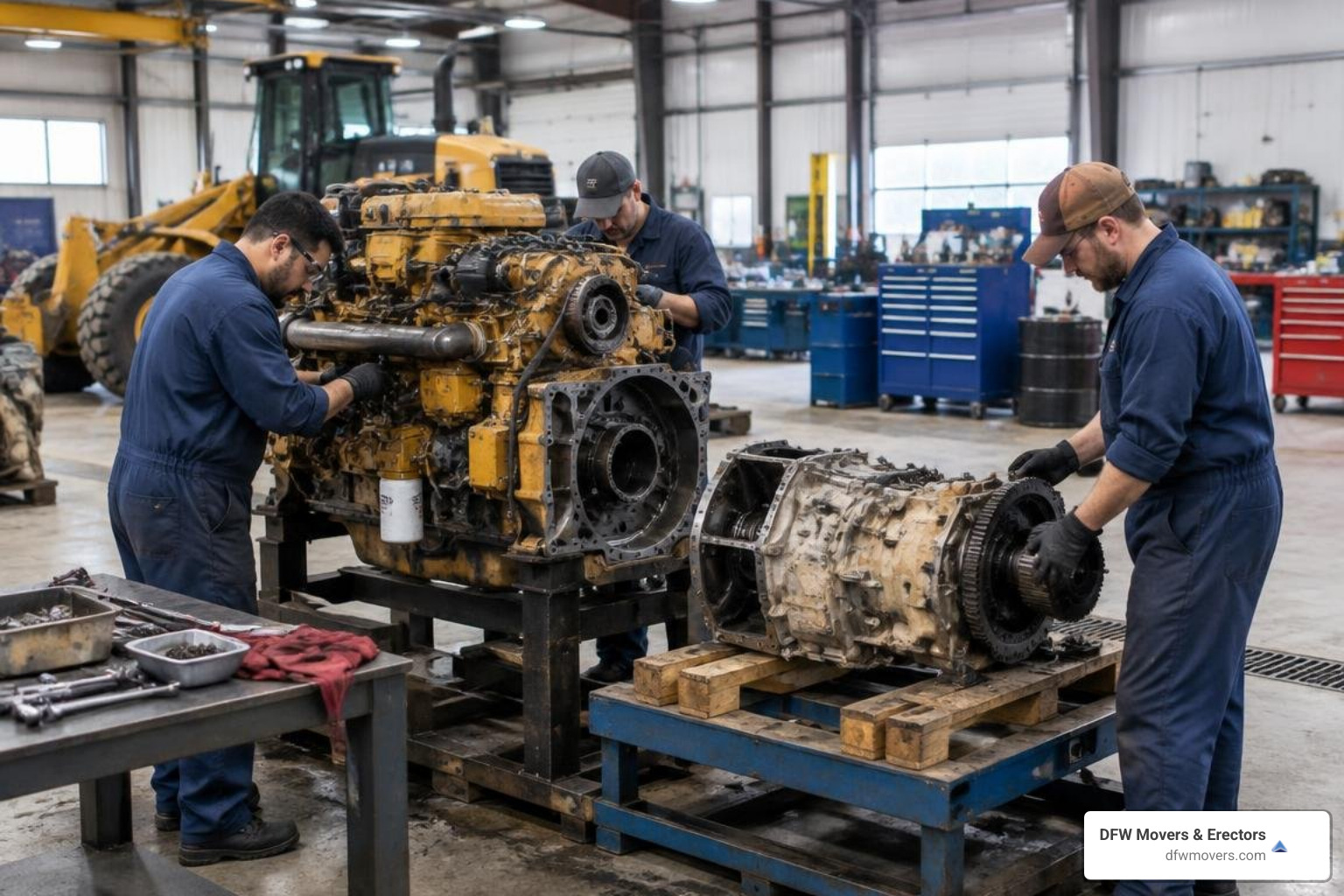
A comprehensive overhaul involves a meticulous multi-step mechanical restoration:
Equipment maintenance is directly linked to jobsite safety. A neglected hydraulic hose can rupture under thousands of pounds of pressure, presenting severe burn and high-pressure fluid injection hazards to nearby workers. Similarly, failing steering linkages or worn braking systems on 50-ton haul trucks pose catastrophic risks on busy industrial sites.
To maintain uncompromising jobsite safety while protecting equipment reliability, operators and fleet managers should implement these proven best practices:
Heavy machinery service encompasses a wide range of technical disciplines. Essential daily and periodic duties include:
Preventive maintenance follows a layered schedule based on operating engine hours:
Heavy equipment technicians typically hold 1 to 3+ years of specialized mechanical trade experience or vocational certifications in diesel mechanics and fluid power systems. Required tooling includes specialized factory OEM diagnostic software, digital multimeter instruments, calibrated torque wrenches, hydraulic pressure gauge kits, heavy-duty pneumatic impact tools, precision micrometers, and specialized hoisting equipment for handling multi-ton components.
Managing complex industrial equipment requires precision, technical expertise, and an unwavering commitment to quality. By establishing structured daily inspection protocols, conducting fluid analysis, utilizing OEM diagnostics, and pairing routine field service with full shop overhauls, Fort Worth operations can maximize machine uptime while extending operational lifespan.
At DFW Movers & Erectors, we have spent over four decades serving businesses across Texas with dependable, highly detailed machinery services. Since 1980, our mission has been simple: providing exceptional service, transparent pricing, and absolute peace of mind with no hidden fees. Whether you require machinery rigging, precision laser alignment, complex equipment installation, or full component repair support, our experienced team delivers reliable execution every single time.
Ready to protect your machinery investment and optimize your fleet’s efficiency? Explore our dedicated Machine Repair Services or contact our team directly at our Fort Worth Location today to discuss your industrial service needs!
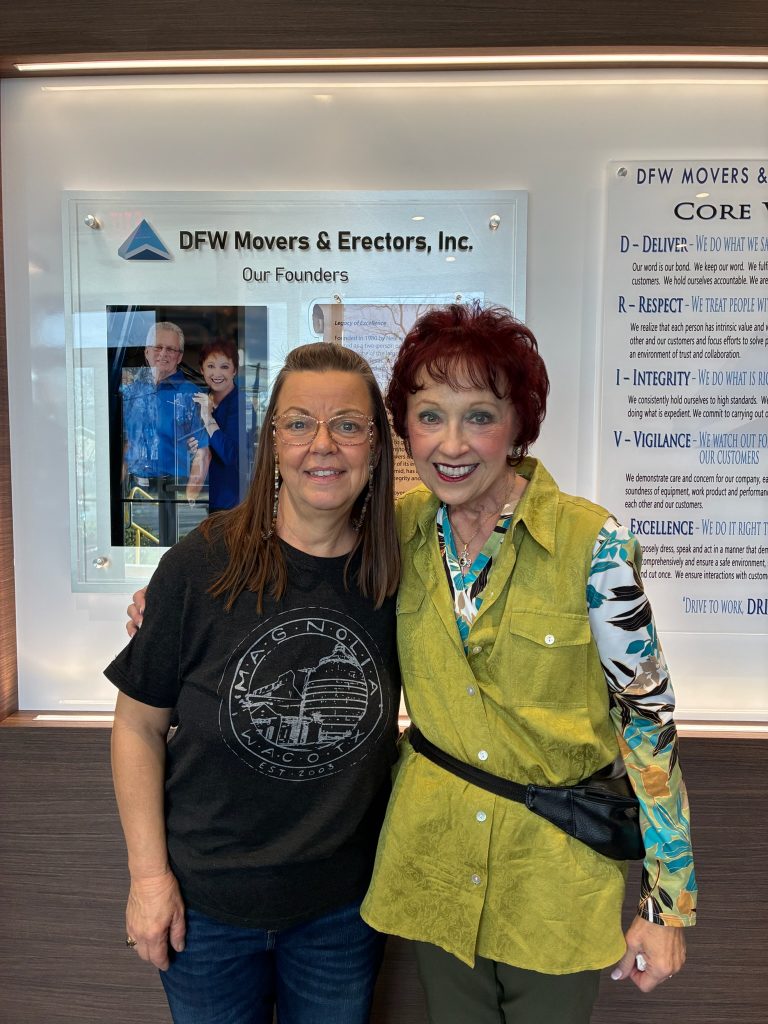
Cheryl Snow celebrated five years with DFW Movers & Erectors in June 2026. She joined the company in Business Development and now serves as a Project Manager.
Cheryl is one of the first people to share good news about the DFW team. Whether she’s telling a customer success story, recognizing a job well done, or passing along a compliment about one of our crews, she makes sure people receive credit for their work.
She also enjoys sharing photos of her family and stories from their travels, so her coworkers often get to hear about their latest adventures.
To mark her anniversary, CEO Joanne Ingle presented Cheryl with her five-year anniversary ring.
Congratulations, Cheryl, and thank you for five years with DFW!
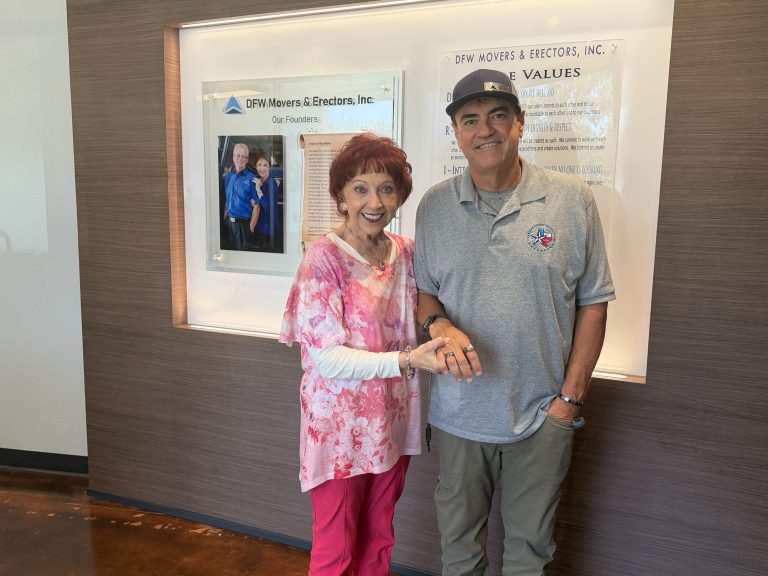
For 15 years, Mike Watson has been an important part of DFW Movers & Erectors. He began his career with the company as a Rigger and CDL Driver. Over the years, his hard work, dependability, and willingness to take on whatever needed to be done led him to his current role as Fleet Safety Manager.
Mike is always ready to lend a hand and brings genuine enthusiasm to his work. He is also a trusted mentor to DFW’s drivers, sharing the knowledge and experience he has gained throughout his career. His commitment to DFW’s Core Values is evident in the way he approaches his work and supports those around him.
That work ethic doesn’t stop at the end of the day. Outside of DFW, Mike stays busy working on his family farm.
In recognition of this milestone, Mike received his 15-year anniversary ring, featuring three diamonds to represent his 15 years of service.
Thank you, Mike, for everything you have contributed to DFW over the past 15 years. Congratulations!
Machine maintenance services are scheduled and responsive programs that keep industrial equipment running safely, accurately, and at full capacity.
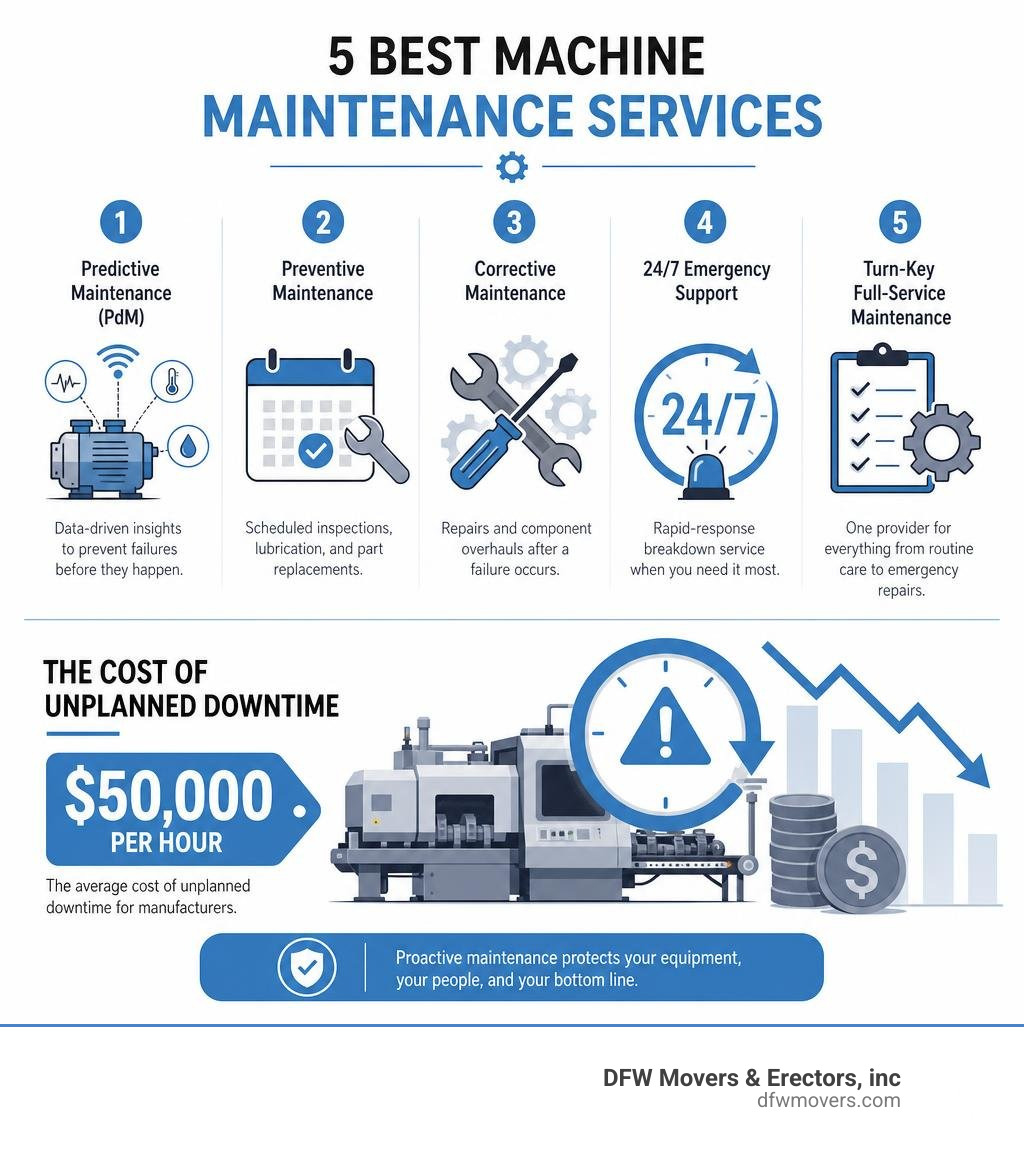
Here’s a quick breakdown of the five best types:
Every operations manager knows the feeling: a machine goes down mid-shift, and suddenly the clock is running against you.
That feeling is expensive. Unplanned downtime costs manufacturers an average of $50,000 per hour. And in most cases, those shutdowns were preventable.
The difference between a facility that hums along and one that lurches from crisis to crisis usually comes down to one thing — the quality of its maintenance program. Whether you’re managing a single production line or coordinating equipment across multiple sites, choosing the right maintenance approach directly affects your uptime, your safety record, and your bottom line.
This guide covers the five best machine maintenance services available in 2026, what separates good providers from great ones, and how to match the right service to your operation.
At its core, machine maintenance services represent a structured approach to keeping your physical assets in peak working condition. This isn’t just about calling a technician when a gear snaps; it is a comprehensive discipline that spans the entire lifecycle of your machinery.
When you partner with a professional service provider, their scope of work typically goes far beyond simple repairs. It begins with routine, systematic inspections to identify early signs of wear and tear. From there, technicians utilize advanced diagnostics to troubleshoot complex electrical, hydraulic, and mechanical issues before they escalate.
A complete service program includes:
Understanding the deep relationship between machinery care and plant productivity is essential. If you want to dive deeper into how these elements connect, read our detailed breakdown on Industrial Machine Repair and Maintenance.
Why invest in a structured maintenance program? Because running your machines to failure is one of the most expensive business models you can choose.
First, let’s talk about equipment lifespan. Industrial machinery is a massive capital investment. Regular care—such as proper lubrication, cleaning, and minor adjustments—can extend your equipment’s operational lifespan by 30% to 50%.
Second, regular maintenance directly impacts productivity. When machines are calibrated correctly, they run faster, consume less energy, and produce fewer scrap parts. You aren’t just preventing breakdowns; you are optimizing your daily output.
Finally, there is safety and compliance. A neglected machine is a hazard. Malfunctioning safety switches, worn hydraulic hoses prone to bursting, and misaligned components put your workforce at risk. Regular safety audits and preventive maintenance ensure your facility meets strict Occupational Safety and Health Administration (OSHA) and industry-specific safety standards, protecting your team and reducing your total cost of ownership.
Industrial facilities are complex ecosystems filled with specialized machinery. A high-quality maintenance provider must possess the technical expertise to service a wide variety of equipment. Some of the most commonly serviced industrial machines include:
Whether your facility relies on high-speed CNC machines in Austin, TX, or massive stamping presses in Houston, TX, keeping these assets serviced is vital to your operational survival.
As we navigate the industrial landscape of July 2026, the technology driving our factories has become more interconnected, precise, and complex. To keep up, maintenance strategies have evolved. No single approach fits every situation; instead, modern facilities deploy a combination of services to achieve maximum operational efficiency.
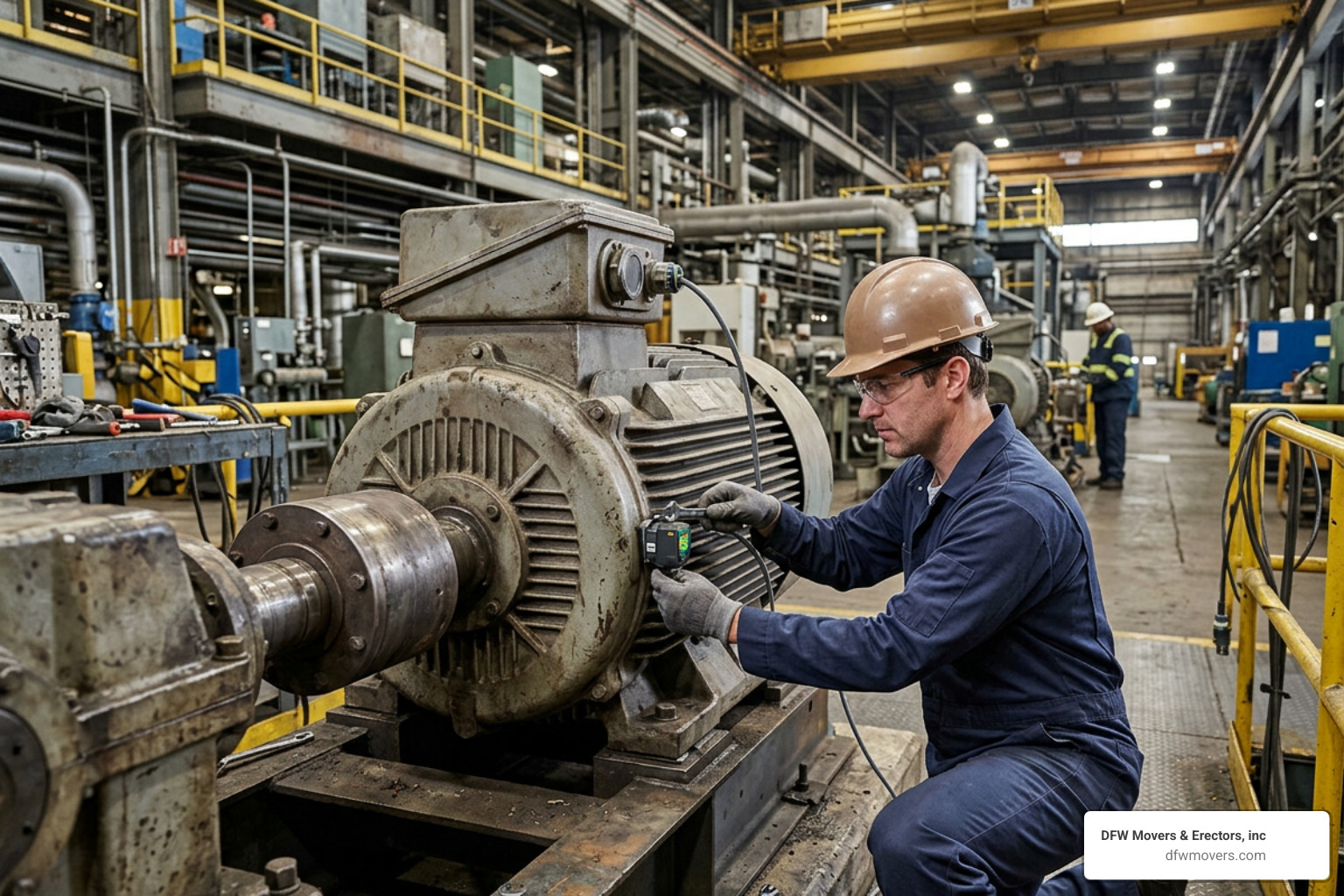
To help you visualize how these services compare, here is a quick overview of the five primary maintenance service types:
| Maintenance Service Type | Approach | Best Used For | Primary Benefit |
|---|---|---|---|
| 1. Predictive Maintenance (PdM) | Data-driven (real-time condition monitoring) | Critical rotating machinery, high-value assets | Catches failures weeks in advance; slashes unplanned downtime by 50% |
| 2. Preventive Maintenance (PM) | Schedule-driven (calendar or run-hours) | All plant assets, wear-and-tear components | Reduces breakdowns by up to 70%; highly predictable budgeting |
| 3. Corrective Maintenance | Event-driven (repairing identified faults) | Non-critical machinery, post-diagnostic repairs | Restores degraded assets to original specifications; root-cause resolution |
| 4. 24/7 Emergency Support | Crisis-driven (rapid-response breakdown) | Unexpected failures on primary production lines | Minimizes costly downtime during catastrophic failures |
| 5. Turn-Key Full-Service | Partnership-driven (complete outsourced care) | Facilities looking to consolidate vendors and scale | Streamlines management, reduces overhead, and delivers massive cost savings |
Predictive Maintenance (PdM) represents the cutting edge of modern industrial care. Instead of guessing when a part might fail based on a calendar, predictive maintenance uses real-time diagnostic data to monitor the actual health of your machinery.
Top-tier providers deploy several non-destructive testing technologies to peer inside your machines while they are running:
The results speak for themselves. Implementing a predictive maintenance program can reduce unplanned downtime by 50% and cut overall maintenance costs by 10% to 40%. By knowing exactly when a component is going to fail, you can order the replacement part, schedule the repair during a planned shift change, and completely avoid a catastrophic breakdown.
While predictive maintenance relies on high-tech sensors, preventive machine maintenance services form the reliable backbone of any successful plant. This strategy is built on a structured, scheduled cadence—usually quarterly or bi-annually—designed to keep machines running within their original design parameters.
A typical preventive maintenance visit from a certified technician includes:
By committing to a regular, scheduled PM program, manufacturers can reduce overall equipment breakdowns by up to 70%. It transforms your maintenance budget from an unpredictable, chaotic emergency fund into a highly manageable, scheduled operational expense.
No matter how robust your preventive programs are, mechanical components will eventually wear out. When a fault is identified during an inspection, or when a machine begins producing parts outside of acceptable tolerances, corrective maintenance is required.
Corrective maintenance is not just a quick patch; it is a systematic process of troubleshooting, identifying the root cause of the failure, and performing a complete component overhaul. For example, if a CNC machine’s spindle is vibrating, a corrective repair doesn’t just mean tightening the bolts—it involves pulling the spindle, diagnosing bearing wear, checking shaft runout, and rebuilding the assembly to factory specifications.
When your machinery requires professional hands-on restoration, you need experienced technicians who can perform high-precision work on-site. Explore our specialized Machine Repair services to see how we get your critical assets back online.
When a primary production line goes down at 2:00 AM on a Tuesday, you don’t have time to wait for normal business hours. Every minute of delay costs thousands of dollars in lost production, missed shipping deadlines, and idle labor. This is where 24/7 emergency support and rapid response services become your operational lifeline.
Modern emergency services begin long before a technician arrives at your door:
Having a trusted partner with a guaranteed rapid-response protocol is the ultimate insurance policy against catastrophic operational delays.
For many modern manufacturers, managing multiple maintenance vendors, stocking thousands of spare parts, and hiring scarce technical talent is a massive operational headache. The solution is transitioning to a turn-key, full-service maintenance provider.
Under a turn-key model, a single partner takes complete ownership of your maintenance department. This includes:
The financial impact of this approach is profound. By consolidating your maintenance needs under a single turn-key partner, you eliminate administrative overhead, improve machine availability, and dramatically lower your total cost of ownership.
When selecting a partner for machine maintenance services, it’s important to look beyond basic toolboxes. The best industrial service providers possess highly specialized, in-house technical capabilities that allow them to execute complex, high-precision tasks without relying on slow, expensive subcontractors.
When a complex repair requires moving massive components, leveling heavy structures, or adjusting structural foundations, you need millwrights who understand precision. Our specialized Rigging Millwright Services combine heavy-lifting power with surgical precision to keep your plant perfectly balanced.
Modern manufacturing tolerances are measured in microns. If a machine tool or conveyor line is out of alignment by even a fraction of a millimeter, it can cause premature bearing failure, excessive tool wear, and high scrap rates.
Top-tier maintenance providers utilize advanced metrology equipment to calibrate your machines:
To understand why precision matters so much for your machinery’s health, check out our guide on the 8 Key Benefits Laser Alignment can bring to your operations. For an even more detailed look at the technology, read Your Complete Guide to Precision 3D Laser Alignment Capabilities.
When a critical shaft snaps or a bearing bore wears out, shipping the massive machine component back to the manufacturer for repair can take weeks. Top-tier maintenance providers solve this problem by offering both in-house machine shop capabilities and portable, on-site machining.
With portable boring bars, flange facers, and milling machines, technicians can perform high-precision machining directly on your factory floor. Whether it’s re-machining a worn bearing seat on a stamping press or performing emergency structural welding by AWS-certified welders, on-site machining eliminates disassembly, transport costs, and weeks of waiting.
Investing in professional machine maintenance is not an operational expense—it is a high-return investment. When you partner with a comprehensive service provider, the financial benefits accumulate across your entire operation:
Choosing a maintenance partner is a decision that directly impacts your plant’s future. To ensure you choose a partner who can deliver on their promises, look for the following key indicators:
The world of industrial maintenance is moving fast. As we look forward through 2026 and beyond, several key trends are redefining how we care for our machines:
While specific intervals depend on your machine’s age, workload, and environmental conditions, we generally recommend scheduling professional preventive maintenance on a quarterly or bi-annual basis. High-use machines operating in harsh environments (such as dusty or high-heat facilities) may require monthly inspections, while lighter-duty assets can be serviced annually. Always consult your manufacturer’s specifications as a baseline.
Preventive maintenance is schedule-based. It involves performing routine tasks (like oil changes, filter replacements, and belt adjustments) at fixed calendar intervals or after a set number of operating hours, regardless of the machine’s actual condition.
Predictive maintenance is condition-based. It uses real-time data from vibration sensors, thermal cameras, and oil analysis to monitor the actual health of the machine, allowing you to perform maintenance only when the data indicates a component is beginning to fail.
When rotating shafts or machine components are misaligned, they create excessive vibration, heat, and mechanical stress. This stress is transferred directly to your bearings, couplings, and seals, causing them to wear out and fail prematurely. Precision laser alignment aligns these components to within microscopic tolerances, eliminating harmful vibrations, reducing energy consumption, and extending the lifespan of your critical wear components.
In the competitive industrial landscape of 2026, keeping your production lines moving is the ultimate key to success. Unplanned downtime is a costly risk that you don’t have to take. By partnering with a professional machine maintenance service provider, you can protect your capital investments, keep your workforce safe, and ensure your operations run at peak efficiency day after day.
At DFW Movers & Erectors, we have spent over four decades helping industrial operations across Texas and beyond manage their heavy machinery. Since 1980, our family-owned business has built a reputation for safe, detail-focused, and highly precise industrial services. From heavy rigging and machinery relocation to precision millwright work, we provide turn-key solutions with completely transparent pricing and no hidden fees.
Whether you need to level a single CNC machine in Fort Worth, TX, relocate an entire production line in San Antonio, TX, or manage a complex industrial project in Houston, TX, our team is ready to deliver.
Ready to optimize your industrial operations? Download our comprehensive resource, The Machinery Moving Playbook for Industrial Operations, to learn how precision planning can transform your next project.
If you’re ready to discuss your machinery maintenance, alignment, or relocation needs, connect with our team of specialists today and put our 45+ years of industrial expertise to work for your business.

When it comes to moving fragile or high-value items, there’s no room for shortcuts. At DFW Movers & Erectors, we understand that many of the items entrusted to us are not only expensive, but often irreplaceable. From fine art and antiques to industrial equipment and sensitive electronics, protecting these items requires the highest standards of planning, materials, and expertise.
We do not take this responsibility lightly. Below, we’ll walk you through exactly how we approach fragile and valuable items, the special considerations we take into account, and the proven methods we use for our crating and shipping services:
Fragile and high-value items face a variety of risks during transport. Shock, vibration, moisture, temperature fluctuations, improper handling, and shifting loads can all lead to damage if not properly addressed. Because of this, we never treat these items as standard freight.
Our first step is understanding exactly what we’re moving. Each item is evaluated based on its size, weight, materials, fragility, and value. This allows us to design a crating and shipping strategy that addresses the specific vulnerabilities of each piece rather than relying on generic packing methods.
One of the most important considerations for fragile and valuable items is cushioning. Proper cushioning absorbs shock, reduces vibration, and prevents movement inside the crate or container.
We use a range of professional-grade materials such as foam, bubble wrap, and specialty padding, all based on the item’s needs. As part of our crating and shipping services, we make sure delicate surfaces are covered with non-abrasive, protective wraps that prevent scratching or pressure marks. We also take into account that heavier items may need high-density foam that can support their weight.
Additionally, we focus on resolving any issues with empty space through immobilization. Items are secured so they cannot shift during transit, which is one of the most common causes of damage. Our team knows one of their objectives is to create a stable, protective environment where the item remains fully supported from all sides.
For many fragile or valuable items, standard boxes simply aren’t enough.
At DFW Movers & Erectors, we design and build customized crating solutions as needed to match the exact dimensions and requirements of fragile and valuable items. These crates are engineered to provide structural strength, weight distribution, and maximum protection during handling and transport.
Custom crates may include:
For especially sensitive items, we incorporate shock-mounted or floating crate designs that isolate the item from external forces. This level of customization significantly reduces the risk of damage, especially for long-distance or complex shipments.
Shock and vibration are unavoidable during transportation, but damage doesn’t have to be. Our crating process focuses heavily on shock absorption and vibration control.
By combining properly rated cushioning materials with tight tolerances inside the crate, we minimize the transfer of energy from the outside environment to the item itself. This is particularly important for artwork, electronics, medical equipment, and machinery with delicate internal components.
For high-value shipments, we may also incorporate shock or tilt indicators. These devices help monitor how the crate is handled during transit and provide valuable information if issues arise.
When items are shipped out-of-state or stored for extended periods, environmental exposure can become a major concern. Moisture, salt air, and humidity can cause corrosion, warping, or deterioration if not properly controlled.
For these situations, we use barrier bagging as part of our crating and shipping services. Barrier bags create a sealed protective environment around the item, often combined with desiccants or corrosion inhibitors. This method is especially effective for overseas transport, where items may be exposed to fluctuating climates and extended transit times.
Barrier bagging is commonly used for:
This extra layer of protection ensures that items arrive in the same condition they were packed in, regardless of the journey.
Proper labeling and handling procedures play a critical role in protecting fragile and valuable items. At DFW Movers & Erectors, we apply strict protocols for all our crating and shipping services.
Crates and packages are clearly labeled with handling instructions such as “Fragile,” weight indicators, and special lifting requirements. These labels are part of a larger system that informs every team member how the item must be handled at each stage.
Our crews are trained to follow strict handling procedures, including:
Temperature and humidity can have a significant impact on certain items. Wood, fine art, musical instruments, and electronics are especially sensitive to environmental changes.
When needed, we offer climate-conscious shipping options and packaging solutions designed to regulate exposure. This may include insulated crating, moisture control materials, or climate-controlled transport depending on the item and destination.
By planning for environmental conditions ahead of time, we prevent damage that might not be immediately visible but can affect an item’s long-term condition.
One area that often gets overlooked in professional crating is documentation and accountability. At DFW Movers & Erectors, we maintain detailed records throughout the crating and shipping process.
This includes condition documentation, photographs before and after crating, inventory tracking, and clear identification of each crate. These records provide peace of mind for our clients and help streamline communication, insurance coverage, and delivery verification.
Precision crating and shipping services require experience, attention to detail, and a commitment to doing things the right way. At DFW Movers & Erectors, we don’t believe in shortcuts, and we are dedicated to protecting what matters most to you.
By combining customized crating solutions, professional cushioning materials, shock-absorbing features, barrier bagging for overseas transport, and heightened handling procedures, we significantly reduce the risk of damage even for the most delicate or valuable items.
Whether we’re moving fine art, specialized equipment, or one-of-a-kind valuables, our approach remains the same: assess carefully, build intentionally, and handle professionally every step of the way.
From local to out-of-state shipments, our crating division CrateMaster can handle any on-site job. We’ll protect your most valuable items with precision and care, no matter where you’re going or what your requirements are. If you need expert, quality crating and shipping services for your specialty packages, contact us today to get a free estimate. We’re ready to deliver your items with reliable protection and unmatched service.

When industrial equipment fails, the issue is rarely isolated to a single broken component. In many cases, the root cause goes deeper: improper rigging, alignment drift, floor settling, vibration, overworked systems, poor lubrication practices, or even infrastructure failures surrounding the equipment itself.
That’s why experienced providers play such an important role in modern machine repair service operations. Industrial machinery repairs require more than replacing worn parts. They demand a deep understanding of how machines behave under load, how facilities impact equipment performance, and how installation, movement, alignment, and long-term operation all connect together.
Since 1980, DFW Movers & Erectors has provided machine repair services, rigging, alignment, machinery relocation, and industrial support services across the United States, Canada, and Mexico. With experience across aerospace, automotive, manufacturing, food processing, pharmaceutical, and HVAC environments, the DFW team has the ability to solve complex machinery problems that less experienced providers may overlook.
One of the biggest misconceptions about machinery repair is assuming the visible failure is the actual problem.
In reality, experienced technicians know that machine and equipment repair often begins with asking the right questions and evaluating the entire operating environment. Machine history, operating conditions, surrounding infrastructure, and movement patterns all play a role in identifying the true cause of failure.
For example, alignment issues are one of the most common contributors to machinery problems after relocation or installation. Even minor misalignment can create excessive vibration, premature wear, bearing failures, coupling damage, and reduced production accuracy over time.
Less experienced providers may focus only on replacing failed components, while seasoned industrial machine repair service teams investigate the broader operational picture to prevent the issue from recurring.
Many industrial repair projects begin long before a repair technician is called. Companies sometimes attempt to move machinery internally without fully understanding equipment weight distribution, rigging requirements, load points, or transport stresses. One of the most common mistakes is underestimating the complexity involved in safely moving industrial machinery.
Industrial equipment is engineered with specific rigging points and lifting requirements. Improper lifting methods can twist frames, introduce alignment problems, damage foundations, or create hidden structural stress that may not appear for weeks or months. Hidden damage caused during relocation often becomes a major contributor to future industrial machinery repairs, particularly when alignment and structural integrity are compromised.
This is where experienced industrial repair service providers bring significant value. Teams with rigging, millwright, alignment, and repair expertise can identify issues introduced during relocation and correct them before they escalate into major production failures.
Complex industrial machinery repairs often involve multiple disciplines working together simultaneously. A machine may require mechanical repair, laser alignment, rigging adjustments, anchoring corrections, or foundation modifications to fully restore performance. Experienced providers understand how these systems interact.
DFW Movers regularly works on equipment that has drifted out of tolerance due to floor settling, vibration, or improper load distribution. Their process begins with a full evaluation, followed by determining the extent of damage and developing a repair solution tailored to the machine and facility conditions.
This is especially important in heavy industrial environments where machinery operates continuously under significant loads. Over time, vibration and repeated impact can physically alter the surrounding infrastructure. Many large-scale industrial machinery repairs originate from years of accumulated stress that gradually impacts machine performance and reliability.
DFW Movers has encountered fabrication presses that sank inches into facility foundations, creating utility problems and production disruptions for both upstream and downstream equipment.
In these situations, simply repairing the machine is not enough. The surrounding infrastructure must also be corrected to restore proper operation.
Not all industrial machinery repairs follow the same standards. Aerospace facilities, food processing plants, pharmaceutical operations, and automotive manufacturers each operate under different compliance requirements, tolerances, and process expectations.
Experienced machine repair services providers understand how to adapt repair procedures to meet industry-specific operational standards. Every industry has its own criteria, protocols, and processes that must be incorporated into repair planning, quoting, and execution.
For example:
An experienced industrial machine repair services provider understands how to operate within these environments while minimizing operational disruption.
Older industrial machinery creates another major challenge for teams performing industrial machinery repairs. Many facilities still rely on legacy or discontinued equipment that no longer has OEM support or readily available replacement parts. Inexperienced providers may recommend full replacement simply because sourcing parts becomes difficult.
Experienced machinery repair teams approach the situation differently.
DFW Movers maintains an in-house machine shop and works with long-standing vendor relationships capable of custom manufacturing replacement parts when OEM support is unavailable.
This capability can dramatically reduce downtime and help companies extend the lifespan of critical production equipment without immediately investing in costly replacement systems.
One of the most important aspects of industrial machinery repairs is determining whether equipment should actually be repaired or replaced. The answer is rarely simple.
The two biggest drivers are typically overall cost and downtime. While replacing equipment may seem like the long-term solution, new machinery can sometimes involve years-long lead times, additional utility modifications, retraining costs, process integration challenges, and expensive rigging requirements.
In many situations, repairing existing equipment becomes the faster and more cost-effective solution once all operational factors are considered.
Experienced machine and equipment repair providers help companies evaluate these decisions realistically rather than defaulting to unnecessary replacement recommendations.
Over decades of industrial repair work, experienced providers begin to recognize patterns that less experienced teams often miss entirely.
Lubrication neglect and overworking machinery remain two of the most overlooked causes of machine failure.
Poor lubrication practices slowly damage bearings, guides, gears, and moving components until catastrophic failures occur. Likewise, continuously operating equipment beyond its intended capacity may not cause immediate failure, but the accumulated stress eventually impacts performance, reliability, and lifespan. Identifying these warning signs early can significantly reduce the scope and cost of future industrial machinery repairs.
Experienced industrial machinery repair teams understand these long-term operational patterns and can often identify warning signs before complete failure occurs.
Industrial machinery repairs are not just about fixing broken equipment. It is about protecting production schedules, maintaining operational continuity, minimizing safety risks, and extending equipment life.
That level of service requires experience across rigging, alignment, machine movement, infrastructure evaluation, diagnostics, and mechanical repair.
When production depends on precision, experience is not optional. It becomes one of the most valuable tools in the entire repair process.
Experience matters when downtime is on the line. From machine repairs and alignment to rigging and relocation, DFW Movers & Erectors helps manufacturers solve complex equipment challenges quickly, safely, and efficiently.
On June 1, 2026, we begin our 47th year in business.
When Neal and Joanne Ingle started DFW Movers & Erectors in 1980, they had two employees and operated out of their home in Irving, Texas. Like many small businesses, growth came one job at a time. As new opportunities came along, so did early equipment purchases, including a tilt-bed truck, a forklift, a trailer, and a tractor.
By the end of the second year, we had grown to 20 employees.
In those early days, Neal and Joanne would drive around after church on Sundays looking for new businesses moving into the area. Joanne would write down company names, and Neal would call them on Monday mornings to introduce the company and set appointments to see their equipment.
“It was amazing to see how we were blessed with new customers,” Joanne said.
One of the moments Joanne remembers most clearly came during the economic slowdown at the end of 1982, when oilfield equipment purchasing nearly stopped.
At a time of uncertainty, they decided to host a Customer Appreciation Party. They brought in barbecue catering, hired a band that played from a trailer in the warehouse, and cleaned and displayed our equipment throughout the building. We invited customers, bankers, and vendors.
Most importantly, they listened to customers.
Those conversations opened the door to new opportunities and services, including warehousing, cleaning and painting equipment, and eventually crating services.
“We got more work from our party than we ever imagined,” Joanne said.
As the company continued to grow, so did the relationships built along the way. Some of those customer relationships are still part of the company today. Joanne says one thing has remained consistent through every season of growth and change: the integrity of the company and the people behind it.
“We now have written down our Core Values, and they have not changed since we began in 1980,” she said.
That core commitment extends to the way employees are valued and recognized today. Team members celebrating milestone anniversaries receive a special ring beginning at five years, with additional diamonds added at years 10, 15, and 20. For 25 years, a diamond is added to the center of the ring. There are additional rewards for those reaching 30 and 35 years of service.
With decades of memories about DFW’s history, one has stayed with Joanne over the years. She remembers one of the company’s earliest Christmas parties where employees and their families were invited to celebrate together, with bonuses, gifts, and Santa Claus handing out presents to the children.
“It was a party to remember,” Joanne said.
“We have always had a great team of employees who were dedicated and worked very hard no matter what the circumstances were,” she said.
Faith has also remained an important foundation throughout the company’s history. One scripture has stayed with Neal and Joanne since the beginning of the business: Matthew 6:34 and the reminder to not worry about tomorrow because God is already there.
“Both Neal and I have lived by this quote,” Joanne said. “We know that God is always with us no matter what we face.”
As we begin our 47th year, we are grateful for the employees, customers, vendors, and relationships that have been part of this journey. We look forward to continuing to serve our customers with the same hard work, integrity, and commitment that have guided us from the very beginning.


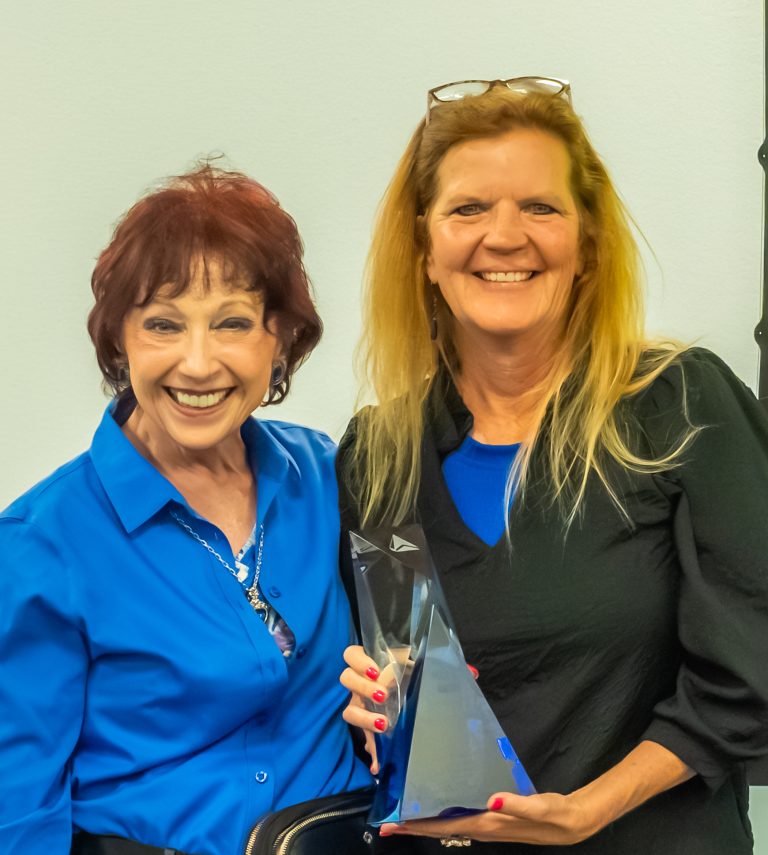
On April 18, DFW Movers & Erectors recognized Sandra (Sandy) Wentrcek, San Antonio General Manager, with the company’s Pyramid Award, which honors employees who demonstrate excellence and set the standard for others to follow.
For over 13 years, Sandy has led the San Antonio location with excellence. Sandy’s commitment to her customers earns her accolades and respect. Her years of experience have built a high level of credibility and confidence with her customers. She has developed a core staff that deliver and meet the rigging needs of customers. In short, the customer calls and the job gets done.
In recognition of consistent positive leadership and performance, senior leadership and ownership presented her with the company’s most prestigious award, the Pyramid Award. We are grateful that Sandy is part of our team of leaders and we appreciate the contribution she has made to the company.
The award reflects the hard work, professionalism, and commitment that continue to shape the culture at DFW Movers & Erectors each day. Congratulations, Sandy!
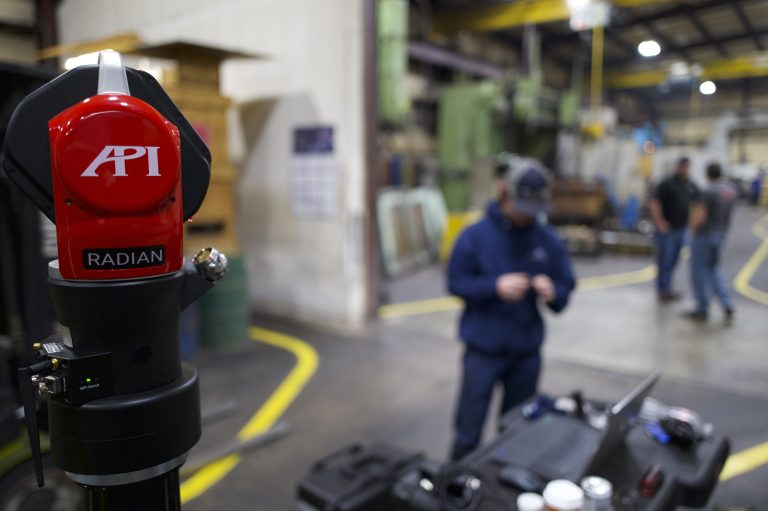
Moving heavy machinery and equipment isn’t an easy process. It requires proper planning, transportation, and precise 3D laser alignments to ensure everything runs smoothly. Every millimeter counts. A small misalignment can affect performance and slowly wear down machinery critical to daily operations.
DFW Movers ensures everything is squared away, inch by inch, to deliver reliable performance and peace of mind, so you don’t have to worry about unexpected downtime or costly repairs.
This guide provides an in-depth explanation of how precision laser alignments are done, what goes into the process, and the technology behind the laser alignment services we provide.
Industrial equipment is built to operate within tight tolerances. During a move, even with careful handling, those tolerances are disrupted.
Common alignment issues after relocation include:
None of these issues look severe at first glance, but they rarely stay minor.
Once the equipment is running under load, these small deviations are amplified. Heat, rotation, and force transfer turn minor misalignment into vibration. Over time, that leads to accelerated wear, bearing failures, and reduced equipment lifespan.
One of the most common mistakes is performing alignment too early.
Alignment can be started in phases during installation, especially on large projects, but final machine laser alignment should always be completed after the system has stabilized. If piping is still being connected, bases are still settling, or mechanical adjustments are ongoing, alignment results won’t hold.
Final alignment should only occur after:
At that point, the system reflects its true operating condition and is then ready for optimization.
Any operation running rotating equipment relies on proper alignment to maintain reliability. These operations include power generation systems, oil and gas equipment, aerospace manufacturing, production lines, and heavy processing environments. In these settings, alignment directly affects how equipment handles load, how efficiently it runs, and how long components last before requiring replacement.
DFW Movers supports alignment across these industries because the underlying challenge is the same: machines must operate within exact tolerances, even after being relocated.
Alignment is all about understanding how equipment behaves once it’s running.
Key factors that influence alignment accuracy include:
Because of this, alignment is sometimes performed to a calculated offset rather than a perfectly straight reading. The goal is not theoretical precision; it’s functional accuracy under real operating conditions.
Alignment should also be treated as part of a broader maintenance strategy. For most facilities, critical equipment is checked on a regular cycle, typically every six to twelve months. Systems that operate under higher loads or speeds may require more frequent checks, especially if they are sensitive to small deviations.
Alignment should be revisited as part of routine maintenance, especially following changes like coupling replacements that can shift system positioning. Many facilities also rely on condition-based monitoring. When vibration increases or temperatures rise unexpectedly, machine laser alignment is one of the first areas evaluated.
In most cases, alignment issues are identified after they begin causing problems. Increased vibration is often the first noticeable symptom. From there, components like bearings and seals begin to fail earlier than expected. Couplings may overheat or show signs of wear, and energy consumption can rise as the system works harder to compensate.
Operators may also notice unusual noise or inconsistencies in production output. These symptoms are rarely isolated; they typically point back to alignment as a root cause. Addressing the issue early prevents more extensive damage.
Traditional alignment methods relied heavily on manual measurements, which introduced variability and left room for error. Modern 3D systems used by leading laser alignment companies remove much of that uncertainty.
These systems provide high-precision, multi-axis measurements while significantly reducing setup time. The results are digitally recorded, making them easy to track, verify, and repeat.
At DFW Movers, technology is only part of the equation. The real value comes from how it’s applied. Our laser alignment services are performed with consideration for operating conditions, system behavior, and long-term reliability, not just initial measurements.
Alignment work should always leave a clear record.
After completion, customers receive detailed documentation that shows exactly what was corrected and how the system was brought back within tolerance. This includes before-and-after readings, correction data, and setup notes.
This information serves as a baseline for future maintenance and provides transparency into the work performed.
Alignment requires coordination between multiple teams to avoid delays and rework.
DFW Movers works closely with customer teams to align schedules, confirm equipment readiness, and coordinate access requirements. This includes ensuring lockout/tagout procedures are in place, mechanical support is available, and piping and electrical work are complete before alignment begins.
This level of coordination keeps projects moving efficiently while minimizing downtime.
One of the realities of alignment work is that it often reveals underlying problems. Issues such as pipe strain, soft foot conditions, foundation instability, or improperly torqued bolts can prevent alignment from holding. In some cases, components like shafts or couplings may already be damaged.
When this happens, alignment becomes part of a larger correction process. The underlying issue must be addressed first, or the system will continue to drift out of tolerance.
For larger systems, alignment is a more structured process. DFW Movers approaches complex projects by first reviewing equipment layouts and identifying critical systems. Alignment is then performed in a defined sequence, typically from driver to driven components, while accounting for thermal growth and operating conditions.
Work is often divided into phases to minimize disruption, allowing alignment to be completed without unnecessarily interrupting production.
Legacy equipment presents its own challenges. Tolerances may not be clearly defined, and older systems often require custom approaches.
In these cases, alignment may involve adapting measurement setups, working within broader tolerance ranges, or reverse engineering alignment targets. Additional corrective work, such as shimming or base adjustments, is often required to restore the system to a stable operating condition.
The objective is not to force older equipment to meet modern standards, but to achieve the highest possible reliability within its design limitations.
DFW Movers has seen alignment issues develop well after initial installation.
In Midland, TX, two press brakes were installed and aligned to operate together, forming sheet metal components. Roughly three years later, the concrete foundation began to fail under the load, causing the machines to shift out of alignment and impacting product accuracy.
Our team returned to assess the issue and performed precision realignment using a laser tracker. By correcting the positional deviations between the machines, we restored proper tolerances and system accuracy.
This case highlights a common reality: even properly aligned systems can drift over time due to foundation movement and operating conditions, making periodic alignment critical to maintaining accuracy.
What separates DFW Movers is not just the tools used, but the methodology behind them. Unlike many laser alignment companies, the DFW Movers approach focuses on real-world conditions, repeatability, and long-term system stability. The team brings experience across multiple industries and is equipped to handle everything from single-machine alignment to complex, multi-system setups.
This approach integrates precision laser alignments into the full lifecycle of machinery moving, installation, and maintenance.
Precision 3D laser alignments are one of the most critical steps following machinery relocation, yet they are often underestimated.
Small misalignments don’t stay small, they develop into larger mechanical problems over time. Proper sequencing, environmental awareness, and ongoing maintenance all play a role in keeping equipment aligned and functioning correctly.
DFW Movers approaches precision laser alignments with the same level of accuracy as the move itself, focusing not just on placement, but on how the equipment performs once it’s running.
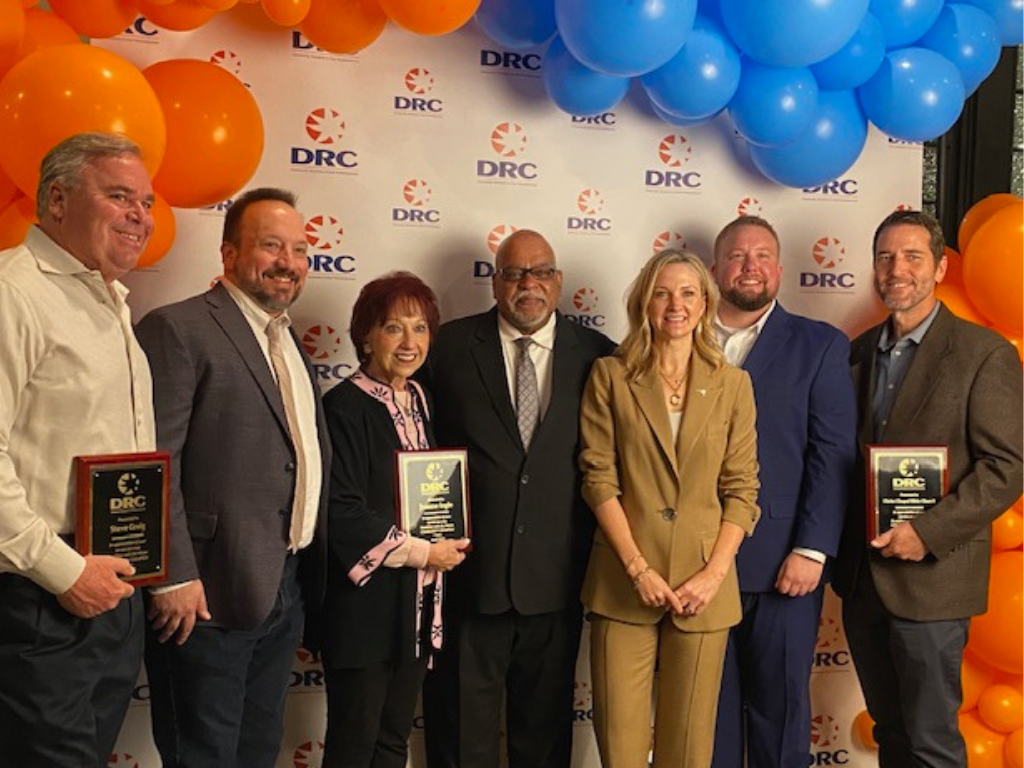
Congratulations to our very own Joanne Ingle! At Fort Worth’s Breakfast with the Mayor event, DFW Movers CEO was honored as a “Community Champion” for her outstanding fundraising efforts for DRC Solutions (DRC). Joanne, along with three others, helped raise the highest amount of support for the organization last year.
The award was presented to Joanne on March 25th at Ridglea Country Club. Congratulations to Joanne on this well-deserved recognition and for making such a meaningful impact on our community!